
CANCELLED - Clothing Design: Draft a Sloper for Your Body 1F26
Age Group:
Adults
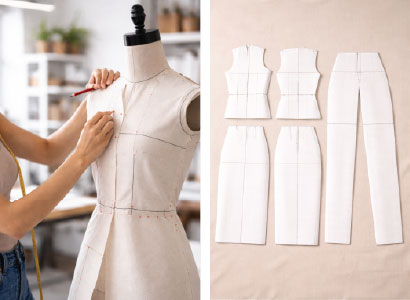
Clothing Design: Draft a Sloper for Your Body
If you’re an experienced sewer ready to take your skills to the next level, sign up for this brand new Eliot School class!
This class is perfect for those who have taken Clothing Design: Alter a Pattern here before, and/or want to learn how to draft their own sewing patterns, and/or are interested in flat pattern making. You’ll learn basic flat pattern making techniques and how to take proper body measurements. Then, you’ll use those skills to make slopers (also known as “pattern blocks”) using your measurements. Each student will cut and sew a muslin version of their pattern for in-class fit analyses. You’ll discuss pattern corrections with your instructor for improving fit on future versions of their sloper block, and walk away with custom bodice and skirt slopers. If there is time, you may also construct a pant sloper.
Class Make-Up Date: Wednesday, 10/28/26
*Prerequisites: intermediate sewing or equivalent experience. This class is designed for intermediate students and above. Must know how to read and use sewing patterns to create clothing. Must know basic garment construction techniques and have experience successfully sewing clothes.
Fifile Nguyen
Fifile (Fi) Nguyen is a former fashion designer specializing in womenswear. She first began taking fashion design classes at the Museum of Fine Arts Houston’s Glassell Junior School of Art, and then earned a BS in Textile & Apparel Design from the University of Texas at Austin. In 2011, she co-founded a clothing line committed to sustainable fashion made through fair labor practices. One of her dresses won first place in the Born Free USA 4th Annual Fashion (Fur Free Fashion) Competition in 2012.
While she is no longer a practicing fashion designer, Fi delights in sharing her knowledge through the Eliot School. She has been a member of our sewing faculty from 2013-17, and 2023 to present. When not teaching Eliot School students, Fi works as a strategy consultant and sits on our board.
Website:
Specialty:
Fashion design, strategic planning
Materials to bring to class:
- Butter paper: This is the paper you will use to develop your slopers. It needs to be thin enough to fold, but thick enough to be durable. It also needs to be semi-see through. They come in yellow or white. Either is fine. This paper will come in rolls of varying widths, I recommend getting 18”, or even 24” rolls. Here are examples of butter paper: Bienfang Canary Sketching and Tracing Paper, Canson Tracing Sketch Rolls, Speedball Tracing Paper in Rolls.
- French curves: A small 4 pack of see through French curves that we will use for pattern drafting. Example: Westcott C-Thru Set of French Curves, approx. $6.
- Clear straight 2” ruler: 18” long, 2” wide clear, bendy plastic ruler with a printed grid in 8ths graph scale. Example: C-Thru Clear Plastic Ruler 8ths Graph Scale 2 Inches Wide.
- Clear Scotch tape: Your standard Scotch Magic tape will do. Make sure it’s matte so that it can be written on! Example: Scotch Magic Tape ¾ inches x 18 yards.
- Fine ballpoint pen in any dark color (black, blue, red, purple, green as desired): Standard cheap BIC pen, that kind of thing. NOT gel because it will smear. We will draw pattern lines with this, so pick a color that won’t be hard to see.
- Tracing wheel: sometimes called a needle point tracing wheel or a pattern tracing wheel.
- Paper scissors: We will have these available at the school for you to use during the entire term. If you are picky (like me), feel free to bring your own.
- Basic sewing kit:
- Pin cushion – I use a tin box. It’s really up to you whether you want to get that tomato or not. Some people swear by those magnetic bowls you can get at a hardware store that are designed to hold nails.
- Machine sewing needles – 5 pack universal machine needles in varying sizes.
- Hand sewing needles – assorted sizes, as many as you want
- Pins – Dritz 300 Count Extra Long Satin Pins (nickel plated steel) or something similar. Please do not get pins with plastic heads - they are cumbersome and will make this class more difficult for you.
- Thread – standard polyester or cotton thread in a small spool, any color
- Tailor’s chalk – Totally up to you and your preferences.
- Fabric scissors – Fabric scissors are so important! I recommend investing in Gingher’s all metal Dressmaker’s Shears, or some similar brand. When taken care of, these can last you a lifetime and cut beautifully.
- Seam ripper
- Measuring tape: Make sure your tape is flexible and that the lines are accurate (!).
- Optional: Hip curve. If you happen to already have one, please bring it. Otherwise, you can use the one supplied by the School.