
Meet 2026 Artist in Residence Corey Watanabe
June 3, 2026
The Eliot School of Fine and Applied Arts Artist in Residence Program engages a Boston-based artist each year to work closely with a group of our Teen Bridge artists to produce a body of public art with community engagement at its core.
This year’s Artist in Residence Corey Watanabe (he/him) is a Japanese and Filipino American interdisciplinary artist, landscape architect, and educator. His work explores the fluxes and flows of nature and its interconnectedness with all other living beings. Now, as our 2026 Artist in Residence, he will explore the interconnected internal landscapes that are formed and transformed by our personal relationships with nature in his residency project, Gardens of Resonance.
“We all have our own internal landscape that is shaped by our experiences with our environment and other people. It's the source of our creativity,” Corey said. “They’re tied to our heritage and relationships with loved ones and the living environment.”
For Corey, his art practice has always been a deeply personal and instinctive response to the world around him. He has used it as a way of processing his experiences and translating them into something tangible.
“Making is an extension of the senses. It allows us to reflect on, connect with, and understand our environment on a deeper level,” he said.
Corey received a BA in Environmental Science and Graphic Design from Northeastern University, but ultimately his interests moved him away from a more traditional scientific path and toward pursuing a master's in landscape architecture from Rhode Island School of Design.
“I’m very grateful for my environmental science background, though it always felt siloed within one way of thinking,” Corey said. “What captivated me about landscape architecture is its highly intersectional nature. It falls at the nexus between the arts, spatial design, environmental issues, ecology, climate change, and people. It’s a field rooted in care.”
Corey's entry into the field wasn’t just shaped by his passion for art and design, but also his deep commitment to environmental justice and the communities most impacted by climate change and environmental degradation.
“At its heart, I believe landscape design is activism. A lot of the reason why I entered landscape architecture is because of how it handles environmental justice and social issues,” he said.
That commitment to justice is also deeply personal, rooted in his own research into how landscapes have shaped and been shaped by his heritage, specifically the environments of Japanese American incarceration during World War II.
“I did a lot of research about the Japanese incarceration, and how my ancestors championed their relationship with the land to reclaim desolate desert prison landscapes as spaces of solidarity, community, and joy. Landscapes like these make up parts of my Garden of Resonance.” Corey said.
This understanding of landscape as a living record of community and identity carries directly into his practice today. He is currently a landscape designer at Agency Landscape + Planning, where he works to ensure that the people most impacted by climate change and systemic inequities have a seat at the table.
“Our mission is to further the agency of people in the design process. A lot of what we work on has a big emphasis on community engagement. We're always figuring out how to bring more people into the conversation of design, especially people who have been historically left out of those decisions,” Corey said.
That process of working with a community is a large part of what makes landscape design so creatively fulfilling for Corey as a practice that begins not at a drafting table but out in the world.
“You're touching the soil, you're looking at the plants, you're taking in all these different environmental influences, and you're meeting with the community. The root of a lot of work that inspires me always starts with some sort of story or some sort of relationship that's found in our experiences and our environment,” he said.
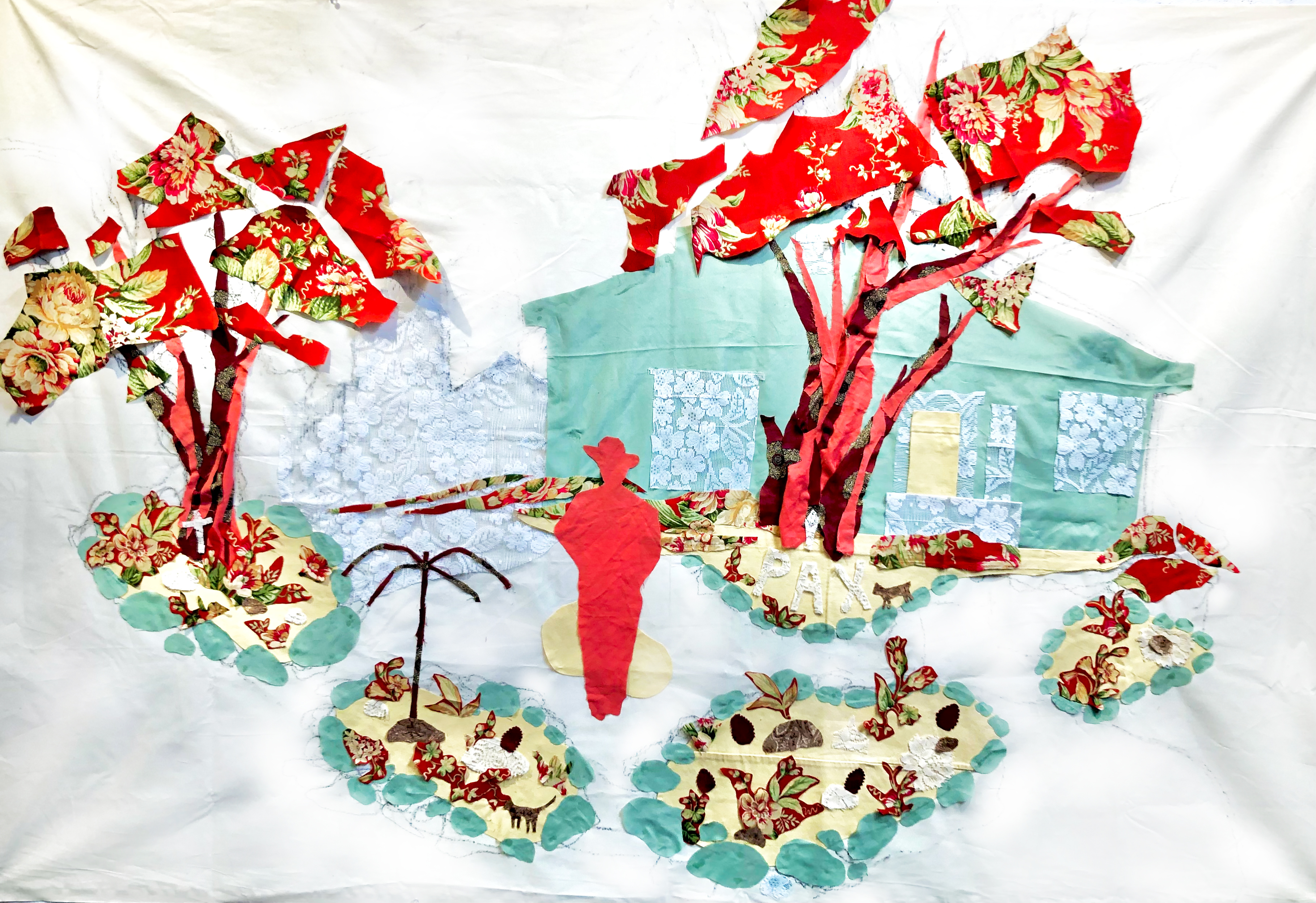
“Lolo’s Garden is a textile collage that I created in reference to my lolo’s (Tagalog for grandpa) yard that he shaped as a sort of a reflection of his own character. You could see ties to his own Filipino heritage coming to life in this garden in the middle of Upland, California,” Corey shared.
In the Eliot School of Fine & Applied Arts 2026 Artist Residency, Corey is excited to help the Teen Bridge artists deepen their relationship with their Gardens of Resonance through site-to-studio workshops. There they will have the opportunity to use a variety of tactile media, including cyanotype, botanical printing, natural dyes, and sensory charcoal, which Corey hopes will help attune their senses to the landscape.
“I think there's a lot that can be learned about how we see the world around us and understand it and unpack it,” Corey said. “I hope to share a new lens that lets them look a bit closer at things they previously just walked by.”
Corey and the Teen Bridge artists will also lead workshops with The Arnold Arboretum, City Sprouts, and The Food Project throughout the residency.
“I wanted this project to be very rooted in the area and spaces familiar to the youth,” he said. “They're all also organizations that are at the intersection between education and green spaces, and they have their own youth organizations that we can partner with.”
By the end of the residency, the Teen Bridge artists will collaboratively create a large-scale quilt that weaves together the interconnected themes found among each student’s Garden of Resonance.
“When I think about interweaving or bringing together people, I think about a quilt,” Corey said. “Historically, quilts have always been this piece that people congregate around to make together. It speaks to relationships between people and relationships with the environment.”
The residency will culminate in an exhibition at Piano Craft Gallery from Friday, August 21 to Sunday, August 23, featuring the work of Corey and the Teen Bridge artists. Join us in celebrating their interpretations of their Gardens of Resonance, as you explore your own internal landscape. Experience this art in community and hear from the artists at our Opening Reception on August 21 from 6 to 8 PM!
More information on the exhibit will be forthcoming, so make sure you subscribe to our newsletter and follow us on social media to stay in the loop. You can also follow Corey’s Instagram account @visceraltraces_ to keep up with the project and his artwork.